Showing posts with label foraging. Show all posts

Sunday, 14 September 2014

The Story of the Chicken of the Wood


I was so happy to find this beautiful 2 kilo bracket of chicken of the wood, or sulphur shelf as it is sometimes known.  My good friend and mushroom expert Mathew Rooney, one half of The Mushroom Table reassuringly confirmed my sighting as the chicken.  Why this giant bracket mushroom is called chicken is only too apparent both in flavour and texture.  As I pondered what to cook, whilst marvelling at my fortuitous find, two dishes quickly sprang to mind. Goulash and a 'chicken' pie.  Rene Redzepi of Noma, eulogised over this mushroom on Dessert Island Disks (8 minutes in), contending that Chicken of the Wood was more rarefied and revered an ingredient than caviar.  For the two week window in which it makes its appearance is known only to 3 foragers in Denmark. 


Freshly harvested and flash fried strips of chicken


Mushroom Matt at work chopping the chicken flesh


Hen in the wood - the 'dark meat' mushroom equivalent

I invited Matthew to join me for a cook up and to glean any mushroom gems.  I was not disappointed; Chicken of the Wood, he tells me can be sliced and dried out, then burned to repel mosquitos.  


Chicken Pie

Matthew advised one of the main pitfalls of this mushroom is the speed at which it can dry out, leaving the chicken 'chalky'.  It is essential to nourish your dish with copious amounts of fat or oil.  In the case of this dish I sautéd the chicken in buttery olive oil with abandon, which was absorbed astonishingly fast.  The raw chicken has a strong lemon flavour, which begs for the addition of lemon juice and rind to enhance its natural citrusy tones.  Although I didn't have my favourite herb, tarragon in, it became apparent that a lemon & tarragon fricassé would be the way to go with this mushroom.  The Hen of Wood (pictured above) was a foraged addition which Matthew brought.  This mushroom, which looks like the feathers of a chicken has the flavour and texture of the dark meat.
  • 75ml olive oil and 50gm butter
  • 1 onion chopped 
  • 1 fat clove of garlic
  • 1 leek washed and sliced
  • 500g thereabouts of chicken of the wood
  • 200g hen in the wood brushed of any dust and shredded
  • 25g flour
  • a good splash of sherry
  • 100ml chicken stock
  • 1 lemon juiced and grated rind
  • a good bunch of parsley chopped
  • 50ml double cream
  • pastry for the lid
  • beaten egg for the baste
  1. Fry the onion in the olive oil and butter, once soft and transparent, add the garlic. 
  2. When the aroma of garlic is released add the leeks and chicken, stir fry for about 4-5 minutes.
  3. Add the shredded hen meat, stir fry for about 4 minutes.
  4. Sprinkle the flour on and cook for 1 minute.
  5. Add the Sherry or wine and allow to evaporate, followed by the chicken stock and mix well.
  6. Allow to cook for about 15 minutes, then stir in the cream and parsley.
  7. Pile into a pie dish and cover with a sheet of puff pastry, paint the top with egg wash
  8. Bake in oven for about 20-25 minutes until the pastry is golden.


Chicken Goulash

The meatiness of mushrooms makes for a hearty goulash and an easy choice.  A rich tomato sauce, laced with piquancy of smokey paprika is a welcome autumn dish.


\


  • 75ml olive oil and 50gm butter
  • 1 onion chopped 
  • 1 fat clove of garlic
  • 2 stalks of celery chopped finely
  • 500g thereabouts of chicken of the wood
  • 2 cans of chopped tomato
  • 1 tablespoon tomato purée   
  • 1 tablespoon best quality smoked paprika
  • Juice of half a lemon
  1. Fry the onion and celery in the olive oil and butter, once soft and transparent, add the garlic. 
  2. When the aroma of garlic is released add the chicken, stir fry for about 4-5 minutes
  3. Add the paprika and coat the contents of the pan well, allow the aroma to be smelt, then add the chopped tomatoes and tomato purée.
  4. Bring to the boil and allow to simmer for 30 minutes.
  5. Add lemon juice & serve.


Monday, 21 November 2011

A day in the forest cooking with acorns


Mighty oaks from little acorns grow

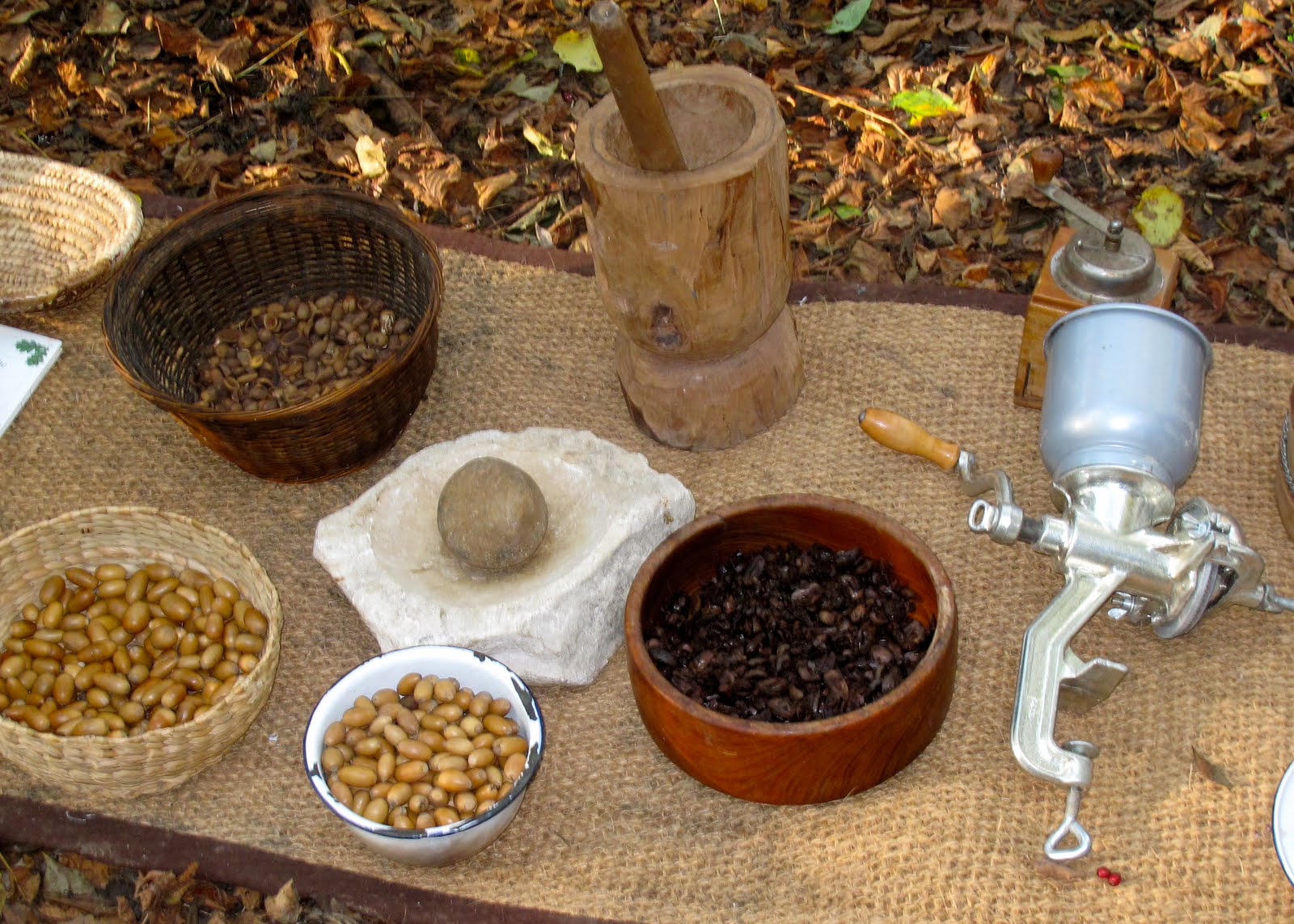
Acorn processing kit

The oak is a mystical, wise and majestic soul. The mighty acorn is the subject of fables, myths and sayings of wisdom. "An acorn holds the promise of a thousand forests". But when it comes to harvesting and eating the fruits of the oak tree there is taboo and a belief that they're toxic and only good for squirrels and swine.

Far from the case, for our stone age ancestors, acorns were the main staple starch food, supplementing hunted meat and foraged berries. Oaks grew abundantly from China, through the far East, Russia, Europe and North America down to Mexico.

This week end I had the chance to rekindle my inner acorn knowledge and reconnect with what my ancient hunter gatherer fore-bearers spent a good deal of their time engaged in the business of processing, cooking and eating acorns. A day in an enchanted forest in Sussex our guide Anna Richardson of Native Hands showed us how to process and cook the fruits of the oak tree.

The rock hard kernels need to be broken & ground down to flour.

The first task in processing acorns is to turn the acorns into flour. Once the acorn is opened, you must break the kernel down. This is best done with a stone grinder (stone age mortar and pestle, family please note Christmas present ideas). Then to grind broken kernels down into flour. We used a maize grinder, though a coffee mill will suffice.

Once ground, it must be leached of bitter tannins.

Next step is to leach out the bitter tannins. Tannin is water soluble so simply many changes of water over 3 or 4 days, until the water is less dark brown will suffice. Then your acorn meal is ready to cook with or to dry out and store.

Acorns have a wonderful buttery & earthy flavour. Anyone who has eaten the Iberico ham from acorn fed pigs will know the wonderful oily flavour of the celebrated charcuterie. This, until recently was my way of indirectly imbibing upon acorns, through the beasts who had consumed them.

Acorn Bread

The day's highlight was the acorn bread baked in a dutch oven. It was a gastronomic top 5 moment, when as the glowing embers were brushed off the cast iron pot, out emerged a triumphant steaming crusty, dark loaf of ancient wheat & acorness. The best tasting loaf I have ever eaten.

The acorn bread was a blend of kamut flour & acorn flour (3parts kamut/1part acorn) kneaded with yeast, salt and water in the usual way and given a day long proving, knocked back twice then baked in a dutch oven.


Dutch oven

Magic moment.

The lovely Anna Richardson beaming with pride at her bread.


Acorn, Hawthorn Berry & Sloe Pudding (authentic stone age special)
Poached apple & sloes - roughly mashed acorn - hawthorn berries
Poach the haws & strain through a sieve
Mix all three together.
Plop into a sycamore leaf and use stalk to thread closed

Leave in the embers of the fire for about 20 minutes.


Open the leaf and enjoy dessert
Fred Flintstone Burgers
Fry some onions, add to acron flour, grated carrot, courgette & anything else you fancy
Form into burger shapes and shallow fry in oil

A memorable day in the woods. I can't wait till next autumn when acorn will be on my menu. Acorn canapes with roasted squirrel and haw jelly?

As a corny, but irresistible foot note I bought these shoes this week. Do they look like an acorn eaters shoes?

Sunday, 26 September 2010

Autumn Foraging


Sloe gin, Hawthorn jelly, Rosehip syrup, Nettle pesto and Nettle soup


Shiny powerhouses packed with Vitamin C


The swallows have departed for about a week, and earlier this week we have seen the autumn equinox with an equal balance of night and day. Now the nights rapidly become longer. Autumn is in full swing and the pickings are rich when out on any walk at the moment. I had a great foraging session in Kent on Friday with my Mum. We gathered haws, hips, sloes and nettles.

Yesterday, I had the pleasure of demonstrating at Belsize Eco Week and used my gatherings for a cook up to the Hampstead Heath foragers. One of the most popular tasters was the nettle soup. Nettles are in season again and are highly nutritious, abundant and free. The nettle pesto served on little squares of bread is always a novelty and a big crowd pleaser.

Nettle pesto See here for Nettle Soup recipe and Nettle Pesto. (Note that soup & pesto recipes were made in the Spring, so omit the wild garlic and for the nettle pesto, use Kent cobnuts - now in season)

The magical hawthorn tree is a delight all year round and now the fragrant blossoms of May have born deep red berries. Haw jelly is said to be good with meat, and by coincidence I was making a huge venison stock today and realised how this would be a natural marriage, assuming that deer would probably be foraging on these berries. To finish a game sauce with a spoon of haw jelly would be an interesting experiment and one I will reporting on this week.

Amongst my haul were sloes, the fruit of the blackthorn, which is a relation of the plum. The blackthorn blossom is a joyful spring sighting. Miles Irving the forager told me that these blossoms make a wonderful almond flavoured infusion. The colour of these plump berries is magnificent. I pondered what to do with them..... sloe jelly is a possibility but my larder is somewhat groaning with various jellies and so opted for sloe gin. This takes about 3 months to mature and so will make a welcome fireside tipple in the mid winter.

Rosehips are a taste of childhood. At the demonstration many faces smiled at the evocation of taste memory on trying some rosehip syrup. One visitor from Belarus told how she made rosehips with her grandmother. They would scrape out the seeds from each hip, which seems greulling labour. However, what a lovely way to pass an evening to be chatting and story telling whilst making rosehips for tea and syrup for the winter ahead.

Rosehip Syrup


Wild rose hips

Rosehips are abundant and very easy to find. The hips are where a rose had been and now turns to seed. I followed Hugh Fearnley Whittingstall's recipe as follows:


The hips picked and cleaned


1Kg hips
1Kg sugar
  1. Pick through the hips, removing the stalks and remains of the rose. Wash, drain and roughly chop (or blitz in food processor).
  2. Bring 2 litres of water to the boil and add the rosehips, bring to the boil and turn off the heat - infuse for half an hour.
  3. Strain through a jelly bag or a colunder lined with a tea towel.
  4. Return the pulp back to the pan with 2 litres of water and repeat the same exercise.
  5. Discard the pulp.
  6. Combine the 2 rosehip waters and boil hard until reduced by half.
  7. Add the sugar and boil hard for 5 minutes.
  8. Pour into seralised bottles.
Sloe Gin


500gm sloes
750ml gin
125gm caster sugar
  1. Pick over the sloes and remove stalks. Wash and drain.
  2. Prick each sloe with a cocktail stick and put in a large steralised jar.
  3. Add the sugar, followed by the gin.
  4. Shake the jar until the sugar has melted.
  5. Put in a dark place and shake every other day for a week.
  6. Shake once a day until the sugar is dissolved. Store in a dark place for 3 months, giving it a shake every now and then, by which time the sloe gin will be ready for drinking or decanting into bottles for christmas presents. (It will keep longer if decanted).
Hawthorn Jelly


Haws from the hawthorn tree


Strain the pulp & juice over night


  • 500gms haws
  • 2 cups water
  • 125 gm sugar
  • 1 lemon
  1. Pick over the haws, removing stalks. Wash and drain.
  2. Add 2 cups of water and bring to the boil and simmer for an hour, mashing every now and then.
  3. Strain through a jelly bag, preferably all night.
  4. Measure the juice and add 450gms of sugar to each 600ml of juice.
  5. Heat the juice in a pan and add the sugar and juice of one lemon, bring to the boil and test for setting point.
  6. Pour into hot steralized jars and seal.


Monday, 30 August 2010

Damson Cheese & other preserves


Pear & date chutney


I couldn't stay away from the preserving pan today. The farmers market was brimming with Autumn's bounty and the urge to wave the preserving wand was strong. Besides, it was a good distraction to the many nagging duties I'm avoiding.

Damsons are one of my favourite autumn fruits, as much for it's dark indigo colour as its sharp distinctive flavour. I keep a jar of damson jelly as a staple, which I add to most meat sauces, especially for game, to give depth and a distinguished colour.

Today I made damson cheese, which I intend to serve with some fine cheeses. It couldn't be easier.

Also a batch of pears from my Mum's garden to make huge pot of pear & date chutney. This goes very well with mature cheddar cheese.

And so my winter larder grew today, as well with redcurrant jelly and blackberry and apple jelly, the product of a happy forage in Kent.

Pears, dates, onion, cinamon and ginger

Wine Dark Cheese

Damson Cheese

This recipe is from Margarite Pattern's Jams, Chutneys, preserves, vingegars and Oils. If you only buy one book on preserving, this is the one.

1 Kg Damsons
450gm caster sugar
  • Cover the damsons in a some water and bring to the boil,simmer for about 30 minutes until the fruit is mushy and soft.
  • Push the fruit through a seive and reserve the pulp.
  • For each 600ml of pulp, measure 450gm of caster sugar.
  • Heat the pulp and and add the sugar. Bring to a rapid boil for about 8 minutes. Check for setting point.
  • Pour into containers, cool.
Pear, Date & Cinnamon Chutney

(This recipe is from Delicious Magazine - I added the ginger)

1 Kg pears chopped small
2 eating apples chopped small
450gm dates chopped
300gm demarera sugar
450gm shallots or onions chopped
5cm grated ginger
600ml cider vinegar
  1. Add the chopped pear, apple, dates, onion, grated ginger, cinnamon sticks to a pan with the 300ml cider vinegar and slowly bring to the boil.
  2. Simmer vigorously for 30 minutes and add the other 300ml of cider vinegar. Boil for a further 30 minutes, until the mixture is thick. (you may need to continue boiling for another 15 minutes).
  3. Pour into steralised hot jars and seal.

Crab Apple Jelly


Seductively warm and amber

Crab apples are rough and ready - don't overlook the rough diamonds.

We are in fully fledged Autumn now, I've spent the last few weeks denying this possibility, indulging in my annual lament at the loss of summer. Luckily the compensation is huge once you accept the departure of the luscious soft fruits, the bright greens, yellows and reds of the peas, pods and shoots and embrace the prospect of building up the larder, preserving the spectrum of Autumn's palate. Damsons, crab apples, plums, blackberries are abundant now, with the quinces and sloes to come.

In the midst of a South London estate lies Moorlands, a tiny treasure of wildlife, nurtured by a community of urban food growers. I was given these crab apples to experiment with.

Crab apples are easy to overlook, they are blighted with dark spots and blemishes and far from the perfect forms we are now accustomed to measuring our foods with. As my pot of crab apples simmered, the sweet perfumed smell of prunus filled the house.

I would implore you not to be put off with the straining and measuring that making a jelly calls for. It really is very little 'actual' time. If you don't have a jelly bag, then a sieve lined with muslin will suffice. And the results by far outweigh the effort.

Thank you lovely folk from Moorlands!


Now what can I preserve.......

This recipe is from the WI Book of Preserves.

(I did not use a lemon and it still worked fine)
  • 1 kilo crab apples
  • 450gms caster sugar
  • Juice of 1 lemon
  1. Simply wash the crab apples, removing the leaves.
  2. Cover in water and bring to the boil, simmer for about 30 minutes, until soft. Mash.
  3. Pour into a jelly strainer and leave overnight. DO NOT PUSH THE MASH THROUGH. (This will cause the jelly to be cloudy).
  4. The next day pour the liquid into a saucepan and measure 450gm caster sugar for 600ml of liquid.
  5. Heat gently and then boil rapidly for about 10 minutes.
  6. Test for a set (crinkle test on a cold saucer).
  7. Pour into hot jars and seal.


Thursday, 13 May 2010

Wild Garlic Potatoes


A simple baked potato, take the middle out and mix with mature cheddar, a little butter or oil, some red onions and wild garlic leaves, season and return to the oven for 10-15 minutes for a delicious and healthy snack.

Saturday, 6 June 2009

Nettle Pesto


I have been focusing on foraged food again. This weekend I took part in a collaboration between Transition Town Belsize Park, 176 art gallery in Camden and a community project. The curator wanted food to be a part of the experience, the smell of bread being baked as you come in, demonstrations of foraged food and samples of local, artisanal food. How enlightened to see food playing a role in such an expression! Visitors didn't hold back in sampling and found the concept of eating nettles utterly fascinating, as I have done, hence my rather new obsession with cooking them. Talking to one man who spends time in Italy, I heard of risotto made with nettles........ of course! How wonderful, I can just see how that would pan out. A good squeeze of lemon juice and lashings of parmesan.

Talking of lemons, I was talking to Lib Dem Eco councillor Alexis Rowell who dropped an excellent tip my way. While feeling rather pleased with my local ingredients, I had used 2 exceptions; the lemon for the elderflower cordial and brazil nuts for the pesto. Cllr Rowell suggested using sorrel in place of the lemon, which I vow to do for my next batch this week. Indeed for anything where we want to add a sour tone, sorrel is abundant here.

I made nettle soup, elderflower cordial and a chilli nettle pesto. The nettle pesto was fun as I tried out a new idea. With a nod to the Transition Town thinking of local, local, local this delicious pesto was the result with the majority being from a 100 mile radius of London, instead of olive oil, I used virgin rapeseed oil from Suffolk, goats cheese from Kent. The chili works really well with the nettles and the goats cheese. It was a major hit with the visitors.

How strange in the un-shockable world we live in, that people generally took a step backwards at the idea of nettles being so delicious and versatile. Nature and it's wondrous generosity and abundance is what stops people in their tracks.

Here's the recipe
  • 125gms freshly picked nettles (tops only and not in seed)
  • 2 Cloves of garlic
  • As much chili as you wish (I used 3 birds eye chili)
  • 50 gms of any nuts (brazils, cashews, walnuts, hazelnuts, pine)
  • 75 gms of hard cheese (try to find a local cheese, goats works well)
  • 120ml virgin rapeseed oil (or hemp oil)
  • Flaky sea salt and ground pepper (Essex sea salt)
Method
  1. Blanch the nettles in boiling water for 1 minute, chill and drain.
  2. In a blender place the garlic, nuts, oil and blitz to a smooth paste then add the nettles.
  3. Add the grated cheese and blitz again.
  4. Season to your taste
This is delicious on bread, or with pasta, particularly good with new potatoes or served as an accompaniment to meat or fish.

The pesto will keep in a clean glass jar for a month in the fridge.

Friday, 29 May 2009

Elderflower Cordial, The Essence of Summer - Cinderella goes to the ball.


Elderflowers in their first flush, shimmering like Cinderella's dress at the Prince's ball


The flowers infusing

The elderflowers have been bursting into millions of tiny white flowers and with the floral erruption comes a sweet and heady scent. Brilliantly white and shimmering delicately, they are the fabric of Cinderella's dress at the ball. The Domestic Fairy Godmother can transform Cinderella's dazzling dress into a summer drink which is the definition of summer itself.

In their first flush the smell is delightfully fragrant, but within a few weeks this delight is lost and just as Ciderella's glass coach turns back to a pumpkin, so the sweetness turns to a rather foul cat's pee aroma...... From the Prince's ball, back to the cinders of the fireplace.

But Cinders can go to the ball, and the magic captured for the rest of the year......... The Domestic Fairy Godmother waves her wand.

On a sunny May afternoon, I picked elderflowers on Hampstead Heath. Clearly a forager and safe person, about 6 people stopped to ask me the way to the here and there. It was like walking with a dog and small child, you're alright. Numerous people asked me what I was doing and how to make it and we chatted about steralising bottles, sugar/water ratio and general delights of elderflowers.

Of the few ingredients for the recipe, you will need some citric acid which you will find from the pharmacist's counter.

So here is the recipe.

The most important ingredient is a happy forage.
  • 20 heads of freshly flowering elderflowers
  • 1.2 litres water
  • 1 kilo sugar
  • 50gms citric acid
  • 2 lemons
  1. Shake the elderflower heads to get any tiny insects out.
  2. Boil the water, add the sugar to disolve.
  3. Clean the lemons and pare the rind, slice the lemons.
  4. Add everything together and pour on the sugar water.
  5. Cover either with a lid or a tea towel and leave to infuse.
  6. Stir twice a day for 5 days.
You really don't need to do 5 days, I am trying it this way this year. But a good 24 hours is essential. 48 even better.

Bottle into steralised glass bottles or plastic bottles. Elderflower cordial freezes very well.

You will taste the summer.

Friday, 1 May 2009

Foraging on Hampstead Heath, Nettle Soup

Clockwise: Nettles, rosebay willow and garlic leaves


Nettle and garlic leaf soup

Nettle & garlic soup garnished with garlic flowers

I spent a delightful Saturday morning foraging on Hampstead Heath.  
Miles Irving of Forager Ltd,  well known amongst the great and good of chefs in the capital who celebrate the best of British seasonal ingredients led a group of 30 to introduce the plants we all walk past every day.  We were introduced to chickweed, burdock, ground elder, cleevers, elderflower (well we all know that one), lime tree leaves (revelation), alexanders, sheeps sorrel, wild plantain, rosebay willow, watermint.   Among  my favourites were the hogweed, not to be confused with giant hogweed which is poisonous, but don't worry, hogweed is hairy and the poisonous one isn't.   This reminded me of a mad scene in a Norman Wisdom film where he is a playing a waiter under cover and has to remember that his task in serving some food is 'the one without the parsley is the one without the poison' - a Norman Wisdom moment follows with him becoming completely confused and jibbering.  Excuse the side track there, but any Norman fans out there may find that remotely amusing.  Miles' tip here was to saute the leaves in black butter. 

Rosebay willow was particularly intriguing as this is a similar stalk to asparagus.   The top tip for me was my personal spring favourite, if not all year round favourite, hawthorn flowers can be eaten!!  In several places around the country this magical tree is known as 'bread and cheese'. One of the fellow foragers recommends using them with red meat casseroles.  Although we had missed the blackthorn blossom by a week, I learned that the blossoms taste of almond, and so blackthorn blossoms can be infused and made into syrup and added to anything sweet throughout the year.  This will definitely be a feature of any menus I offer next spring.

It was possibly the most inspiring talk I have been to all year.  Since then I have my eye on the foliage all around and see that there is indeed a whole world of possibility that we completely take for granted.

Inspired by the weekend I have just made some nettle and garlic soup  served with rosebay willows.  All foraged and free from Kent.  

Miles has a new book coming out in July, The Forager Handbook, which I eagerly await.  

The recipe for the luminously green soup I made is quite simply

  • 1 onion chopped
  • 1 large potato chopped small
  • a good knob of butter (or rapeseed oil)
  • a big handful (NOT LITERALLY) nettles (the top 6 inches)
  • a big handful of wild garlic leaves
  • water and seasoning
  1. Saute the onion for 2 minutes and follow with the potato to soften.
  2. Add the water and cook till the potato is cooked through.
  3. Add the nettles - carefully
  4. When they look cooked, about 3/4 minutes add the garlic leaves and blend.
  5. Serve with a garlic flower.